Normandy Road Trip: Étretat, Honfleur & Mont-Saint-Michel
Driven in this order, the route runs roughly 400 km west, from the Seine valley to the edge of Brittany. Giverny sits upstream on the Seine and Honfleur near its mouth, and the drive finishes on the Couesnon, the river that traditionally marks the border between Normandy and Brittany.
These five stops trace a thousand years of Norman history, from the Conquest to the Impressionists to 1944, and the millennium of William the Conqueror's birth has brought the region fresh attention. The trip suits drivers who want art, medieval history and coastal walking in one week and don't mind packing a raincoat in July.
Listen to this guide
Prefer to listen? This guide is also a 6-minute episode of our podcast.

Also available as Trip Ideas by Ottimo AI on Spotify, Apple Podcasts and other podcast apps.
Giverny
Why Visit
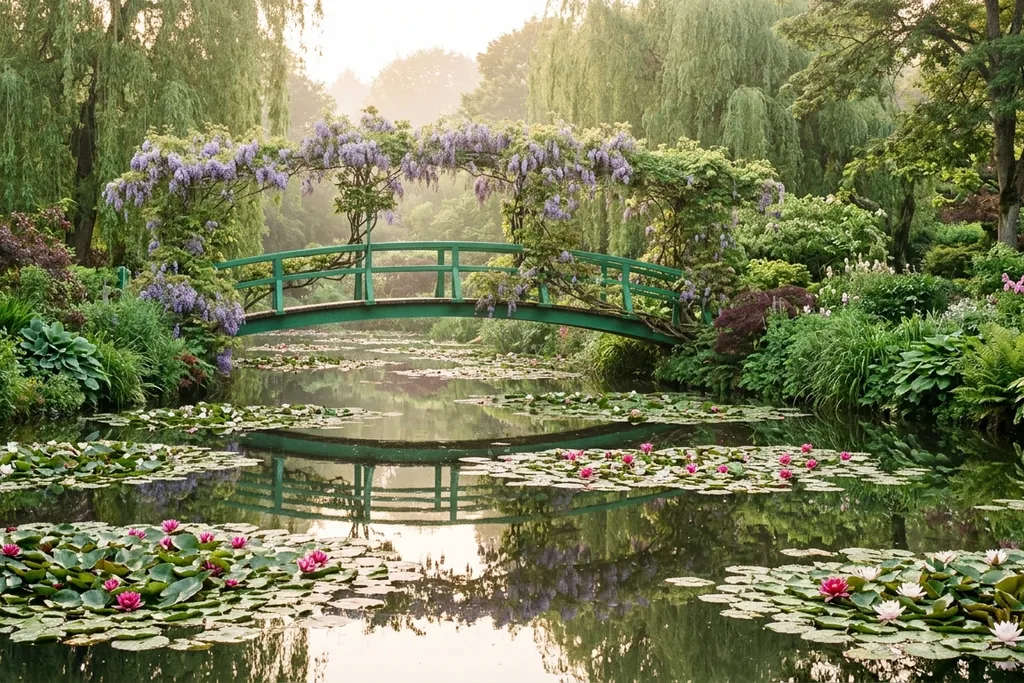
Monet's water lily pond is man-made. In 1893 he bought a plot across the road and railway line from his house. He then diverted a branch of the river Epte to fill it. Villagers objected because they feared his foreign plants would poison their water.
Monet had arrived in 1883 and rented a pink farmhouse with green shutters. The village had a few hundred people and sits where the Epte meets the Seine. He bought the house in 1890 and spent 43 years shaping the grounds as subjects to paint. Around 250 of his water lily canvases came from that pond. The arched Japanese footbridge echoes the woodblock prints he collected.
After his death in 1926, the garden decayed for decades. What you walk through today is a restoration begun in the late 1970s, replanted from photographs and his own paintings.
When to Travel
The house and gardens open only from spring to autumn and close over winter, so plan for roughly April to October. Each month looks different. Tulips flower in April, and wisteria and irises frame the bridge in May. Water lilies bloom from June into September, and dahlias and nasturtiums spill across the central path by September. The Seine valley is mild, with summer highs in the low to mid 20s°C and showers in any season.
Crowds peak in the late morning, when coach tours from Paris arrive, and on weekends from May to July. September is the best compromise: the lilies are still out and there are fewer school groups. Half a day covers the house and garden. A full day lets you add the village and its Impressionism museum.
What Not to Miss
Go to the water garden first. Most visitors start in the Clos Normand flower beds by the house, so the pond is quietest in the first hour. Reach it through the underpass and walk the full loop in about 30 minutes, before a photo queue forms on the bridge.
Inside the house, look at the colours. The dining room is painted in two shades of yellow, and the kitchen is lined with blue Rouen tiles. Most middle-class French homes of the time were dark inside. The walls hold Monet's Japanese prints, including works by Hokusai and Hiroshige.
Then walk along Rue Claude Monet to the churchyard of Sainte-Radegonde, where the family grave stands. To drink, look for Normandy cidre bouché. It ferments a second time in a corked bottle, which is why it fizzes without any added gas.
Takeaway
Book a timed garden ticket online and take the earliest slot of the day. If you come by train from Paris Saint-Lazare to Vernon, the few kilometres into Giverny follow a flat path along an old railway line. Renting a bike in Vernon beats queuing for the shuttle bus.
Étretat
Why Visit
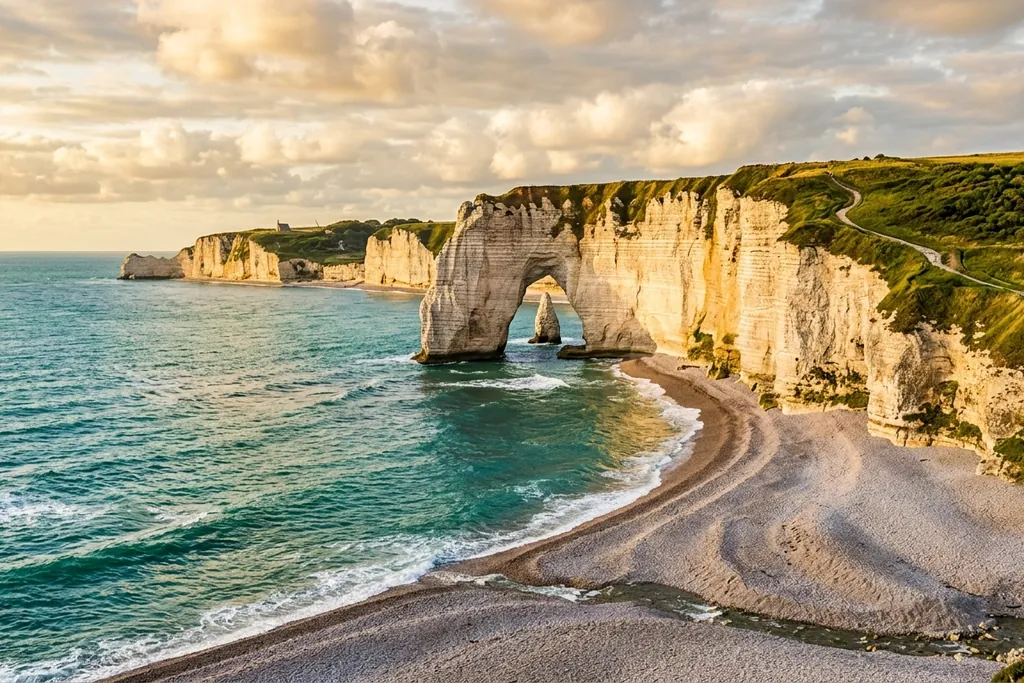
The needle off Étretat's beach is a chalk spike about 51 metres high, and a 1909 bestseller claimed it was hollow. Maurice Leblanc, who had a house here, made it the hiding place of the French kings' treasure in his Arsène Lupin novel 'L'Aiguille creuse'.
The cliffs are the same white chalk as Dover's. It formed from the skeletons of microscopic plankton in a warm sea around 90 million years ago. The dark horizontal stripes are bands of flint. Waves attack cracks in the soft chalk and cut caves, which widen into arches. That process made the Porte d'Aval, the Porte d'Amont and the larger Manneporte. The needle is the piece the sea has already cut free.
Those shapes drew painters. Courbet worked here in 1869, and Monet painted dozens of canvases of these cliffs in the 1880s.
When to Travel
Étretat faces the open Channel, so the wind matters more than the temperature. Summer highs reach around 20°C and winter sits around 5-8°C. Autumn brings the most rain and the strongest gusts, which make the clifftop paths unpleasant.
The town has only a small year-round population and sits within easy weekend reach of Paris by car. It fills up on summer weekends and bank holidays, and by mid-morning parking becomes the main problem. May, June and September give you long evenings with far fewer cars. One full day covers both cliffs. Staying the night lets you see the arches at sunset and low tide without the day-trippers.
What Not to Miss
Climb the Falaise d'Amont, on the east side, first. At the top are the chapel of Notre-Dame de la Garde and a memorial to Nungesser and Coli. The two French aviators vanished in 1927 while trying to fly nonstop from Paris to New York, and Étretat was the last place anyone saw them. From there you face the Aval cliff and the needle, the view Monet painted. Late afternoon light is best on the chalk.
Then cross the beach and take the path up the Falaise d'Aval towards the Manneporte, about an hour there and back. The common mistake is walking near the edge. The chalk overhangs and falls without warning.
Leave the flint pebbles on the beach. They protect the foot of the cliff, and taking them is illegal. From October to May, order Normandy scallops, which may only be dredged in that season.
Takeaway
Don't drive into the centre on a summer weekend. Use the overflow car parks signed on the approach roads, or arrive before 10am. Check the tide table before any walk below the cliffs, because the rising sea cuts off the beaches beyond the arches.
Honfleur
Why Visit
Quebec City was founded from this harbour. Samuel de Champlain sailed from Honfleur in 1608. For the next two centuries the port traded with Canada, the Caribbean and Africa, and that trade included enslaved people.
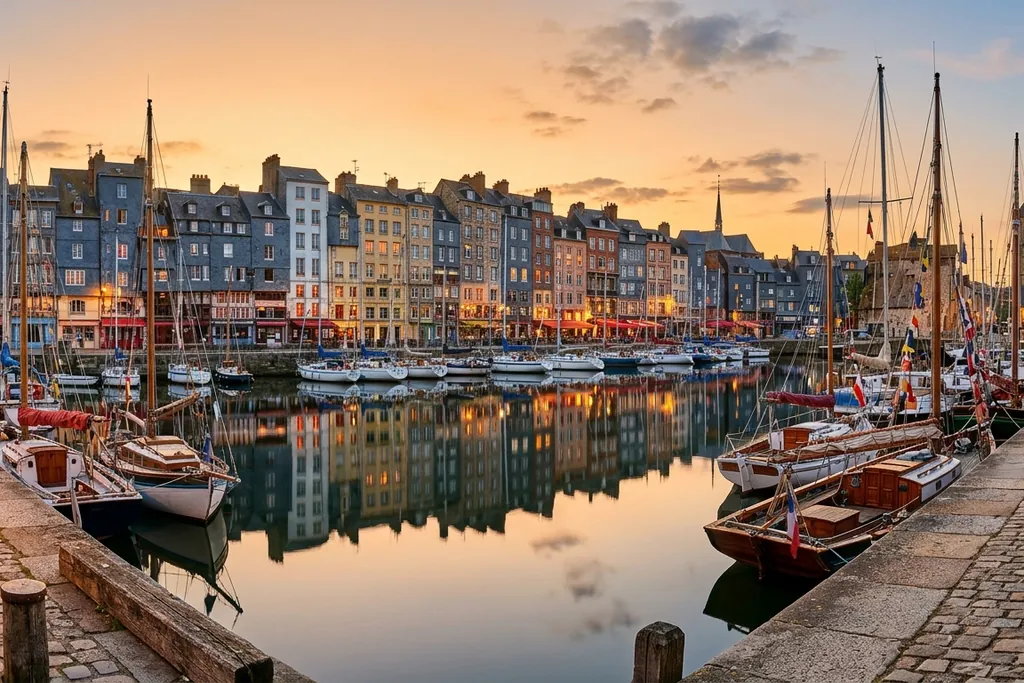
The Vieux Bassin, the harbour basin in every photo, was rebuilt in the late 17th century on the orders of Louis XIV's minister Colbert. It sheltered ships from the Seine estuary's tides. Land around the basin was scarce, so houses grew upwards: some quayside fronts rise six or seven storeys but are only a few windows wide. Slate and wooden shingles cover the timber frames to keep out the Channel rain.
Honfleur escaped the 1944 bombing that flattened Le Havre across the estuary, so its medieval street plan survives. Eugène Boudin, born here in 1824, taught a teenage Monet to paint outdoors.
When to Travel
The weather is much like Étretat's but a little more sheltered. Expect around 20-22°C in summer, 5-8°C in winter, and rain in every month, heaviest in autumn and early winter.
Honfleur is about two hours from Paris. That brings the biggest crowds on summer weekends and the long May holidays, and the Vieux Bassin is packed from late morning. At Pentecost, in May or June, the Fête des Marins decorates the fishing boats for a blessing at sea. April to May and late September to October are the best months. Give the town a night and a day. Allow two days if you also want to explore the Pays d'Auge, the cheese and cider country just inland.
What Not to Miss
Start at Sainte-Catherine, the largest wooden church in France. Local shipwrights built it after the Hundred Years' War, when stone and masons were scarce. Its two naves have ceilings shaped like upturned hulls. The bell tower stands apart across the square, probably so that a lightning strike would not burn down the whole church.
Walk the quays of the Vieux Bassin before 10am, when the café terraces are empty. Then climb the steep lane to the Côte de Grâce, about 20 minutes. At the top is the chapel of Notre-Dame de Grâce, hung with sailors' offerings, with a view over the estuary to the Pont de Normandie.
Eat crevettes grises, the small brown shrimp from the estuary. They are cooked on the boats and eaten whole with bread and salted butter. Finish with pommeau: apple juice blended with Calvados apple brandy and aged in oak.
Takeaway
Book a room for the night and stay until the day visitors leave in the early evening. The quays are emptiest then, and restaurant tables are easiest to get. Don't drive into the old centre; use the large car parks by the outer harbour and walk five minutes.
Bayeux
Why Visit
The Bayeux Tapestry isn't a tapestry. It's embroidery: wool stitched onto linen, about 70 metres long and 50 centimetres high. It was probably made in England, perhaps in Canterbury, within a few years of 1066.
It was most likely commissioned by Bishop Odo, William the Conqueror's half-brother, for the cathedral he consecrated here in 1077. For centuries it hung in the nave once a year. It tells the Norman side of the story. In 1792 it was nearly cut up to cover a military wagon.
Bayeux got lucky again in 1944. On 7 June it became the first town in France liberated after D-Day, with almost no fighting. Its medieval centre survives intact, while nearby Caen was largely destroyed. A week later, de Gaulle made his first speech on liberated French soil here.
When to Travel
Bayeux sits about 10 km inland, so it is slightly calmer than the coast. Summer highs reach the low 20s°C, winters average 7-8°C, and rain falls fairly evenly through the year.
Crowds peak in early June, around the D-Day anniversary. Veterans' groups, re-enactors and convoys of restored military vehicles fill the area, and rooms sell out months ahead. July and August are busy with family holidays, and the town holds medieval festivities in its old streets in July. April, May and September are calmer, and the beaches are still good for walking. Give Bayeux two or three days: one for the town, and at least one for the landing beaches.
What Not to Miss
See the tapestry first thing in the morning. The audio guide sets a brisk pace, so walk back afterwards to study the details. The lower border is full of fables, farm work and naked figures that most people miss. Look too for Halley's Comet, stitched in as an omen of 1066.
Walk to the Commonwealth War Cemetery on the ring road, the largest British Second World War cemetery in France, with over 4,000 graves. The Latin inscription on the memorial opposite translates as: we, once conquered by William, have freed the Conqueror's native land.
Arromanches, with the remains of the Mulberry harbour, is about 10 km north. Omaha Beach and the American Cemetery at Colleville lie roughly 20 km northwest. Back in town, order teurgoule, rice baked for hours in milk with cinnamon. The cinnamon dates from the spices that came through Normandy's colonial ports.
Takeaway
Confirm that the tapestry is on display before you plan around it. A major renovation of its museum and a planned loan to the British Museum in London mean it may be away from Bayeux for an extended period. If it's away, the cathedral and the Battle of Normandy museum still justify the stop.
Mont-Saint-Michel
Why Visit
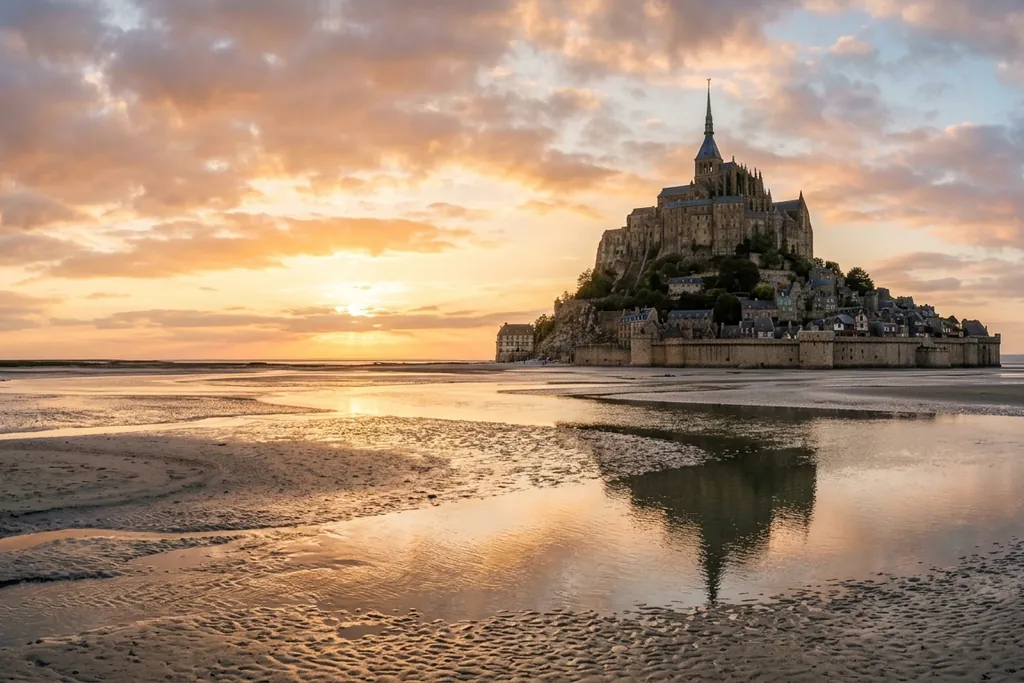
The bay around Mont-Saint-Michel has some of the biggest tides in continental Europe, up to about 14 metres between low and high water. At low tide the sea pulls back more than 10 km. On the highest tides it comes back fast enough to catch walkers out, and the rock becomes an island again.
The abbey began with a vision. In 708, Aubert, bishop of Avranches, said the archangel Michael had ordered him to build a church on the rock. Benedictine monks arrived in 966. The Gothic buildings on the north face, known as La Merveille, went up in the 13th century. The granite rock rises steeply out of the sand, and the spire with its gilded statue of the archangel lifts the summit high above the bay.
During the Hundred Years' War, the Mont held out against English sieges for decades. After the Revolution it became a prison until 1863.
When to Travel
The bay has a mild maritime climate. Summer highs reach around 20-22°C and winters average about 8°C. Rain falls across the year, and the wind off the bay makes the ramparts feel colder than the forecast.
Between two and three million people visit each year. In July and August, the single main street is packed shoulder to shoulder from late morning to late afternoon. The biggest tides come around the equinoxes, in March and September, when the sea surrounds the Mont completely for a few hours. Late September and October combine those tides with thinner crowds. One full day is enough, but stay the night nearby so you can see the rock at dusk and dawn.
What Not to Miss
Climb to the abbey first, before the tour groups reach it around midday. The visit takes about 90 minutes and ends in the cloister of La Merveille, where a double row of offset columns stands above the sea on the north side. Most visitors spend their time on the Grande Rue instead, which is the most crowded and least interesting part.
Walk the ramparts for views over the sand, then go back out across the bridge, which opened in 2014. It replaced an old causeway that had let silt build up around the rock. A dam on the river Couesnon now flushes that silt away to keep the Mont an island.
The local dish is agneau de pré-salé, salt-meadow lamb. The lambs graze salt marshes that the highest tides flood, and the salt-tolerant grasses flavour the meat. The lamb has its own protected appellation. Order it in the mainland villages.
Takeaway
Book a guided walk across the bay from Genêts or Bec d'Andaine, and never attempt the crossing alone. Quicksand and fast tides have killed walkers here. The barefoot crossing takes a few hours and shows you the Mont the way medieval pilgrims approached it.
Travel east to west. Giverny is closest to Paris, so start there, then head for the coast at Étretat and cross the Seine estuary to Honfleur before continuing to Bayeux and finishing at Mont-Saint-Michel. Allow seven to nine days, with overnight stops on the coast and near the Mont rather than day trips. Before you book a car, check whether you can collect it in Paris and return it in Brittany. Rennes is the nearest major rail hub to the Mont, so a one-way hire saves a long drive back.
Frequently Asked Questions
Is Giverny worth visiting?
Yes, especially if you love Monet. His house and gardens are where he spent 43 years shaping the grounds he painted, including the man-made water lily pond behind around 250 canvases. Book the earliest timed garden ticket and head straight to the water garden, which stays quietest in the first hour before the photo queue forms on the Japanese footbridge.
When is the best time to visit Étretat?
May, June and September are the sweet spot for Étretat, with long evenings and far fewer cars than peak summer weekends. Autumn brings the most rain and strongest gusts, which make the clifftop paths unpleasant. If you can, stay overnight to see the arches at sunset and low tide once the day-trippers leave, and always check the tide table before walking below the cliffs.
What is Honfleur known for?
Honfleur is best known for its Vieux Bassin, the picturesque harbour basin lined with tall, narrow, slate- and shingle-clad houses, some rising six or seven storeys. It's also a port with deep history: Samuel de Champlain sailed from here to found Quebec City, and for two centuries ships traded with Canada, the Caribbean and Africa. Unlike nearby Le Havre, it survived wartime bombing largely intact.