Waikato Road Trip: Hobbiton, Waitomo Caves & Raglan
Watch the Waikato Road Trip video distraction-free 0:24
Plot the four stops on a map and Hamilton sits near the middle, with Matamata to the east, Waitomo to the south and Raglan to the west. The city works as a hub, and no leg of this loop needs much more than an hour or so of driving. That compact layout makes Waikato, on Frommer's Best Places to Go in 2027 list, an easy region to cover without long days in the car.
Farmland links every stop: a film set on a working farm, caves beneath grazing country, a black-sand surf town on the Tasman and themed gardens beside the river. The trip suits film fans, families, beginner surfers and anyone who prefers short drives to long ones.
Listen to this guide
Prefer to listen? This guide is also a 6-minute episode of our podcast.

Also available as Trip Ideas by Ottimo AI on Spotify, Apple Podcasts and other podcast apps.
Hobbiton Movie Set (Matamata)
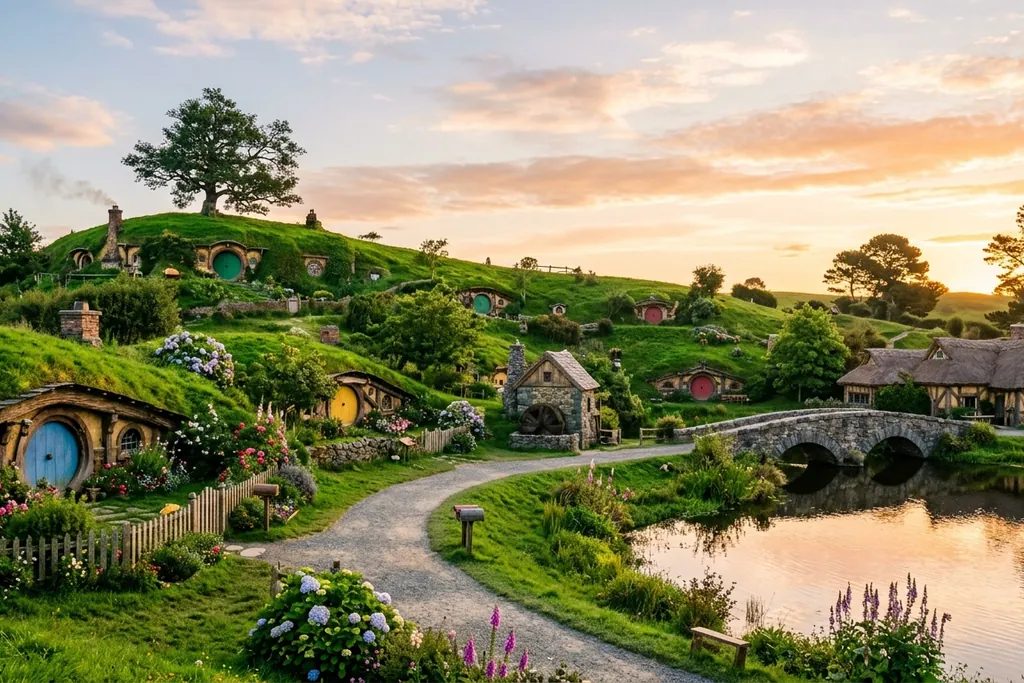
Why Visit
The oak tree above Bag End is fake. It's built from steel and silicone, and its artificial leaves were wired on by hand, then repainted when their colour faded on camera.
The set sits on a family-owned working sheep and beef farm near Matamata. Peter Jackson's location scouts spotted it from the air in the late 1990s. They saw a lake, a large pine and rolling pasture, with no roads or power lines in view. The broad valley nearby is old riverbed. The Waikato River once flowed north through the Hinuera Valley toward the Hauraki Plains, until volcanic debris shifted it onto its current course many thousands of years ago.
The Lord of the Rings set was plywood and polystyrene, and most of it was pulled down after filming. For The Hobbit films it was rebuilt in permanent materials. That rebuild is why 44 hobbit holes still stand.
When to Travel
Matamata summers reach the mid-20s Celsius. Winter days sit around 13 to 14 degrees, often after frosty mornings. Rain falls year-round and is heaviest in winter, but tours run in the wet. Crowds peak from December to February, when New Zealand's long school holidays overlap with northern-hemisphere visitors. Mid-morning slots fill first because day-trippers drive down from Auckland, a couple of hours to the north.
The best shoulder season is March and April. The gardens are still full and the light is lower and warmer. In October and November, lambs are in the surrounding paddocks. Hobbiton needs half a day. The guided walk takes around two hours including the bus ride across the farm.
What Not to Miss
Look closely at the doorways. Hobbit holes were built at different scales, some around 60 percent and others closer to 90. That forced perspective made actors look larger or smaller on film. Most visitors don't notice until a guide points it out.
The vegetable gardens and orchards are real. Full-time gardeners grow the pumpkins, beans and fruit, so the set looks lived-in each season. Autumn produce is the most photogenic.
The walk ends at the Green Dragon Inn, rebuilt in permanent form for The Hobbit films. A drink here is included in the standard tour. The ales and ginger beer are brewed exclusively for the inn and aren't sold elsewhere, so pick the cask ale over a soft drink. If you can stretch to the evening tour, the lanes are lit with lanterns and the day groups have gone.
Takeaway
Book the first tour of the morning online well ahead, especially for December to February. You can only enter on a guided tour. By mid-morning, the group ahead will appear in every photo you take of Bag End.
Waitomo Caves
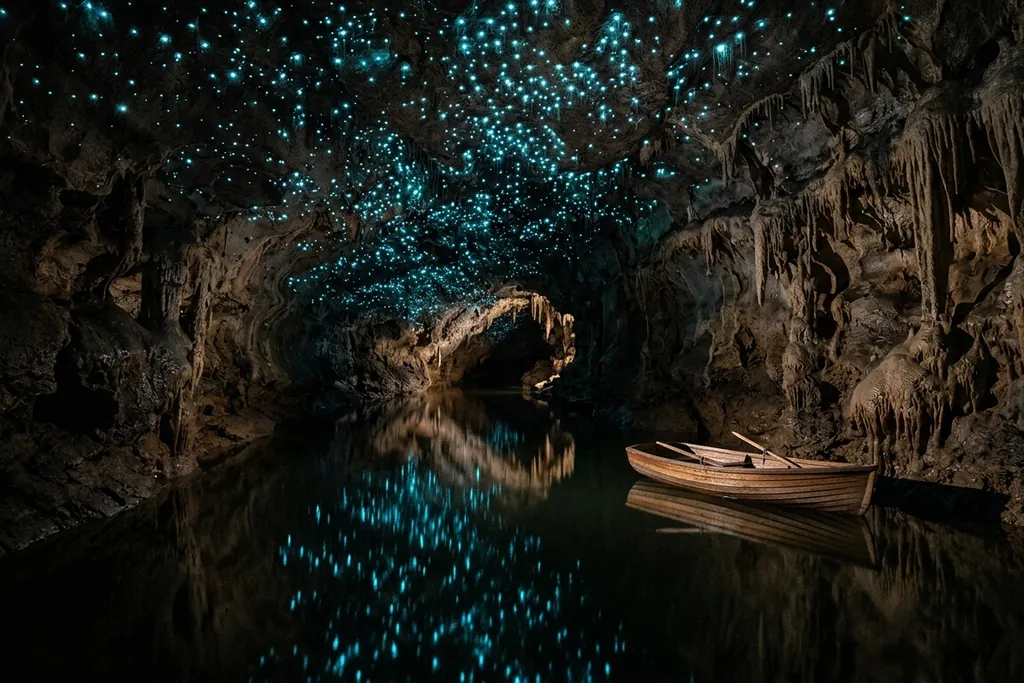
Why Visit
The lights on Waitomo's cave ceilings aren't worms. They're the larvae of a fungus gnat found only in New Zealand, Arachnocampa luminosa. Each larva glows to lure insects into dangling threads of sticky silk. The adults have no mouths and live only a few days.
The caves exist because this land was seabed around 30 million years ago. Shells and skeletons piled up into limestone, and the limestone later rose above the sea. Slightly acidic rainwater then dissolved channels through it. Hundreds of caves are now known in the district. The name comes from Māori: wai means water and tomo means shaft or hole.
Local Māori knew the caves long before 1887. That year, chief Tane Tinorau and English surveyor Fred Mace rafted in along the underground stream. The Glowworm Cave was returned to its original owners in 1989, and many guides are Tinorau's descendants.
When to Travel
Underground, it barely matters when you visit. The caves hold a steady temperature in the low teens Celsius all year. Above ground, summers reach the low-to-mid 20s and winters are cool and damp. Heavy rain can raise underground streams and cancel rafting trips, so leave a spare day in winter.
Crowds peak from December to February and through the middle of the day. That's when coaches running between Auckland and Rotorua stop here. Early morning and late afternoon tours are noticeably quieter. Nearby Te Kūiti celebrates its shearing heritage with competitions that draw crowds from across this sheep-farming district. Give Waitomo one full day and a night. Add a second day for the coast road west.
What Not to Miss
The Glowworm Cave ends with a silent boat ride under the lit ceiling. Photography is banned, so stop reaching for your phone and look up. Before the boat, the Cathedral chamber shows how well limestone carries sound.
For something wetter, try black-water rafting. You float on inner tubes through the Ruakuri system in a wetsuit, and trips take a good part of a morning or afternoon. Book ahead in summer.
Further west along the winding Te Anga road are Mangapohue Natural Bridge, a limestone arch, and Marokopa Falls. Both are short walks.
For food, take the short drive to Te Kūiti and find a local bakery for a mince-and-cheese pie or a lamb pie. The King Country is shearing and sheep country. The town has a giant statue of a shearer, and Waikato dairy goes into the cheese.
Takeaway
Walk the Ruakuri Bush track about an hour after dark. It's free, and glowworms line the banks. Switch off your torch and wait a minute for your eyes to adjust, because the glow is invisible under any light.
Raglan
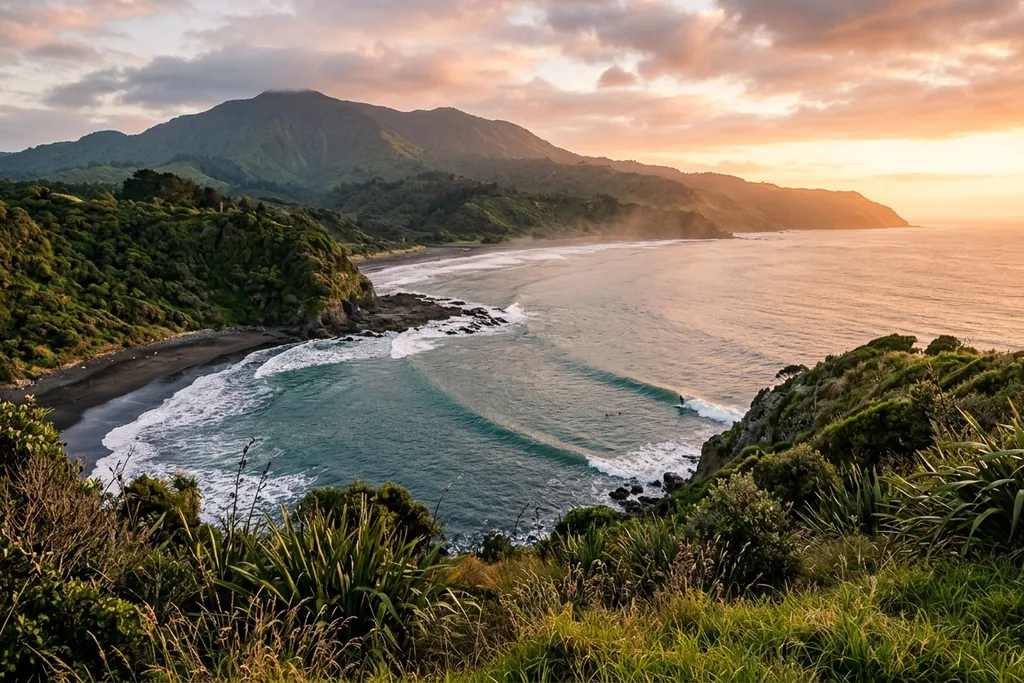
Why Visit
Hold a magnet over the sand at Ngarunui Beach and the black grains jump to it. The sand is titanomagnetite, an iron-rich mineral eroded from the volcanic rocks of Taranaki to the south. Ocean currents carried it north along the coast.
The surf has a geological cause too. A string of rocky points west of town faces the prevailing southwesterly swell. Waves peel left along them for hundreds of metres. The break at Manu Bay featured in the 1966 surf film The Endless Summer, which put Raglan on surfers' maps worldwide.
The Māori name for the harbour is Whāingaroa. The settlement was renamed in the 1850s after Lord Raglan, the British commander in the Crimean War. Land at Te Kopua was taken from local Māori for a wartime airfield and later became a golf course. Protests led by Eva Rickard, including arrests in 1978, saw it returned in the early 1980s.
When to Travel
Raglan faces the Tasman Sea, so wind shapes every day. Summer highs reach the low 20s Celsius, with sea breezes building by early afternoon. Winters are mild, around 14 degrees, but wet and gusty. Winter also brings the biggest swell, which suits experienced surfers.
The town's small population swells in the summer holidays, from late December through January. Hamilton day-trippers fill the beach car parks on sunny weekends, since the city is under an hour away. The best shoulder months are March and April. The sea is still warm from summer, and mornings are often windless. Give Raglan two days, with one of them set aside for Mount Karioi.
What Not to Miss
Mount Karioi is an extinct volcano rising 756 metres just south of town. The climb to its lookout is steep and uses chains in places. Allow most of a morning. On clear days you can see Taranaki.
Bridal Veil Falls, or Waireinga, drops about 55 metres over a basalt lip. It's a short, easy walk from the car park. The lower viewing track adds stairs but shows the full plunge.
In summer, local kids jump off the footbridge into the inlet near town. Only go at high tide, because the channel shallows fast on the ebb.
For food, get fish and chips at the wharf. Look for snapper or gurnard from boats working this coast. Smoked kahawai is worth trying too. Smoking this oily fish is an old Māori preserving method still common along the west coast.
Takeaway
Learn to surf at Ngarunui Beach, which is patrolled by lifeguards in summer. Leave Manu Bay and Whale Bay to experienced surfers: they are rocky points with strong line-up etiquette, and beginners get shouted at or hurt.
Hamilton Gardens
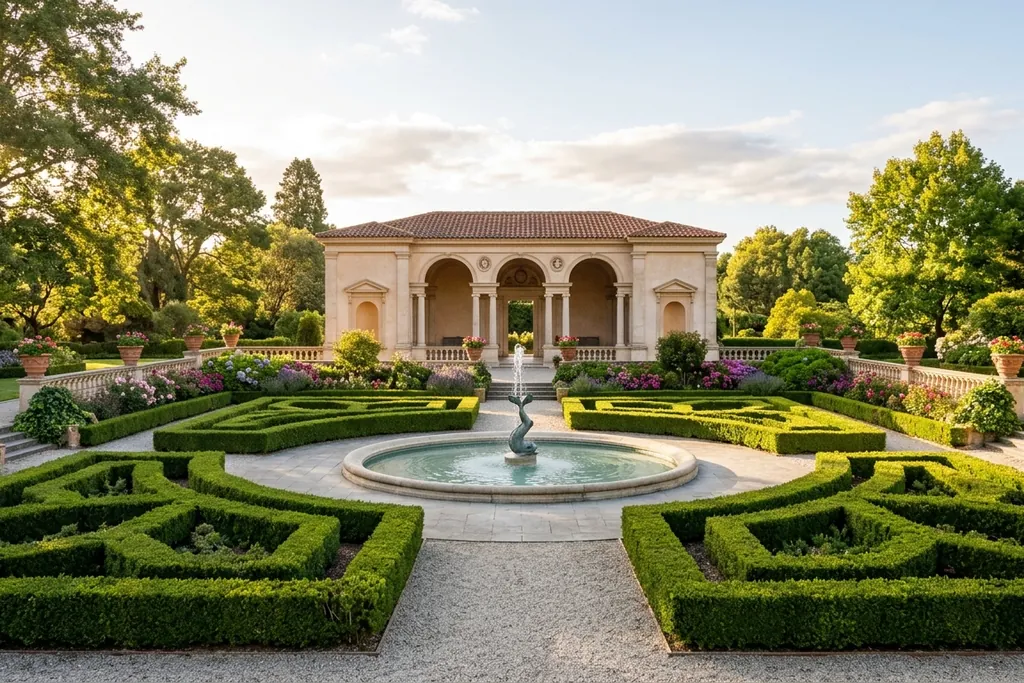
Why Visit
Hamilton Gardens is built on an old rubbish dump. The site beside the Waikato River was a landfill and sand quarry until development began in the 1960s.
The gardens aren't a botanical collection. Each enclosed garden recreates a moment in garden history: an Italian Renaissance garden, a Chinese Scholar's garden, an Indian Char Bagh split into four by water, a Tudor knot garden and a Surrealist garden. The concept has since won international recognition, including a garden-of-the-year award.
Te Parapara, the Māori productive garden, explains what stood here before the city. Hamilton was founded in 1864 as a military settlement on land confiscated after the Waikato War. Long before that, Māori farmed kūmara along the river. The Waikato is New Zealand's longest river, at about 425 kilometres.
When to Travel
Hamilton sits in an inland basin, sheltered from the coastal wind but humid. Summer highs average around 24 Celsius and occasionally hit 30. Winter brings frosts and thick morning fog that rises off the river and often lingers until late morning.
The gardens are planted to work in every season. Spring, from September to November, is strongest: magnolias come first, then roses peak in November and December. In late summer, the Hamilton Gardens Arts Festival stages outdoor theatre and music inside the gardens, and it is worth checking the dates when you plan. Weekends and school holidays are busiest, while weekday mornings are quiet. Allow half a day, or a full day if you walk the river path too.
What Not to Miss
The Surrealist Garden plays with scale. Giant topiary figures and a huge door make adults feel child-sized. Go early, before families arrive.
In the Tudor garden, look for the painted heraldic beasts on poles. They're a copy of a 16th-century fashion that few garden reconstructions bother with.
Te Parapara shows how kūmara, a sweet potato brought by Polynesian voyagers, grew this far south. The Waikato was near the plant's cold limit. Māori quarried sand and gravel and mixed it into garden soil to warm and drain it, and old pits still mark the river terraces. Kūmara remains a staple. Order it roasted or as chips anywhere in town, and look for the gold and red varieties.
A common mistake is ignoring the river. A riverside path runs from the gardens back toward the city centre.
Takeaway
Arrive on a weekday morning, and go straight to the Surrealist and Italian Renaissance gardens before tour groups and families reach them. In winter, wait until the river fog lifts before you go, usually by late morning.
Coming from Auckland, start at Matamata, then head west to Hamilton Gardens and on to Raglan before turning south to Waitomo. That order avoids doubling back and leaves you on the main road south toward Taranaki if you're continuing. Five to six days covers the loop without rushing. Before you go, book a rental car. Buses link Hamilton with the larger towns, but the farm roads, trailheads and cave entrances are hard to reach without your own wheels.
Frequently Asked Questions
Is Hobbiton Movie Set (Matamata) worth visiting?
Yes, even if you're not a die-hard fan. The 44 hobbit holes were rebuilt in permanent materials for The Hobbit films, and full-time gardeners keep the vegetable plots and orchards growing so the village feels lived-in. Look for the forced-perspective doorways built at different scales, then finish with a drink at the Green Dragon Inn, included in the standard tour.
How many days do you need in Waitomo Caves?
Give Waitomo Caves one full day and a night, plus a second day if you want to explore the coast road west. That's enough for the Glowworm Cave's silent boat ride, a black-water rafting trip through the Ruakuri system, and a free after-dark walk on the Ruakuri Bush track. In winter, leave a spare day in case heavy rain cancels rafting.
What is Raglan known for?
Raglan is best known for its surf, especially the long left-hand waves that peel for hundreds of metres along rocky points west of town. The break at Manu Bay featured in the classic surf film The Endless Summer, putting Raglan on the global surf map. It's also famous for black, iron-rich sand at Ngarunui Beach that jumps to a magnet.